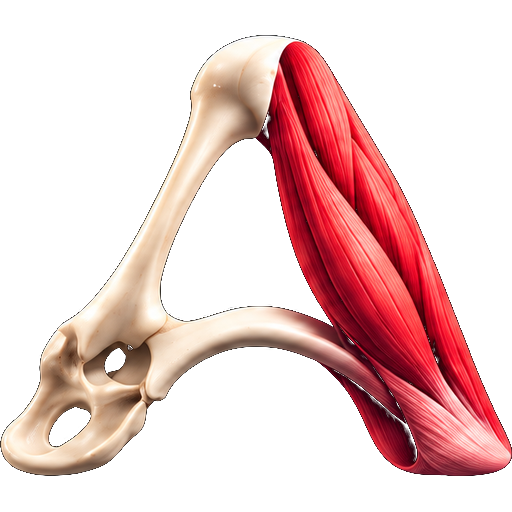
Adductor pollicis
M. adductor pollicis
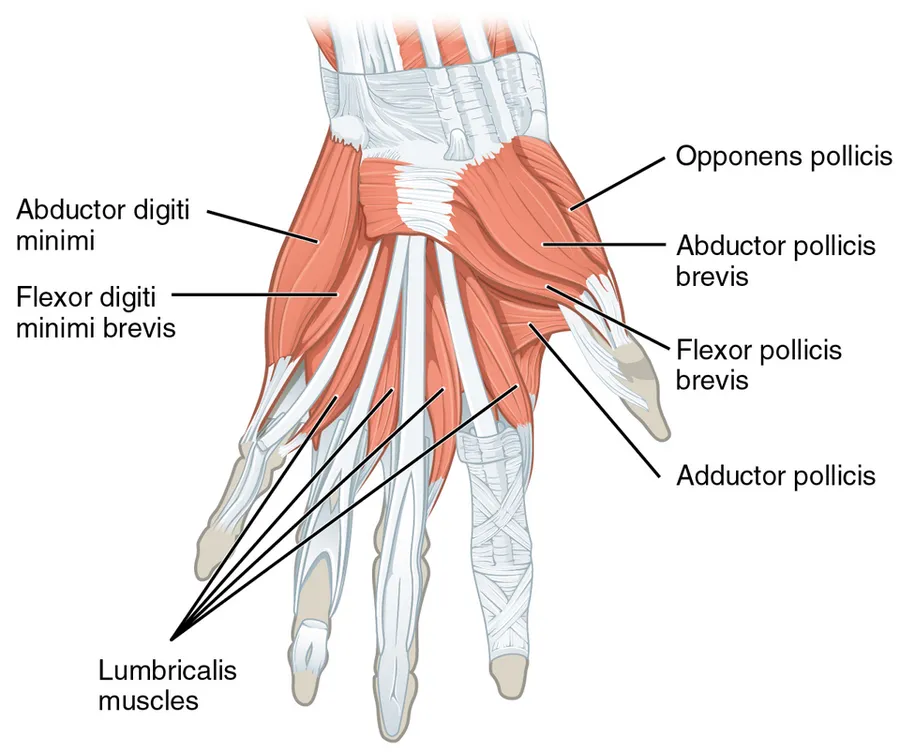
View the adductor pollicis in 3DIn human anatomy, the adductor pollicis muscle is a muscle in the hand that functions to adduct the thumb. It has two heads: transverse and oblique.
It is a fleshy, flat, triangular, and fan-shaped muscle deep in the thenar compartment beneath the long flexor tendons and the lumbrical muscles at the center of the palm. It overlies the metacarpal bones and the interosseous muscles.
Oblique head
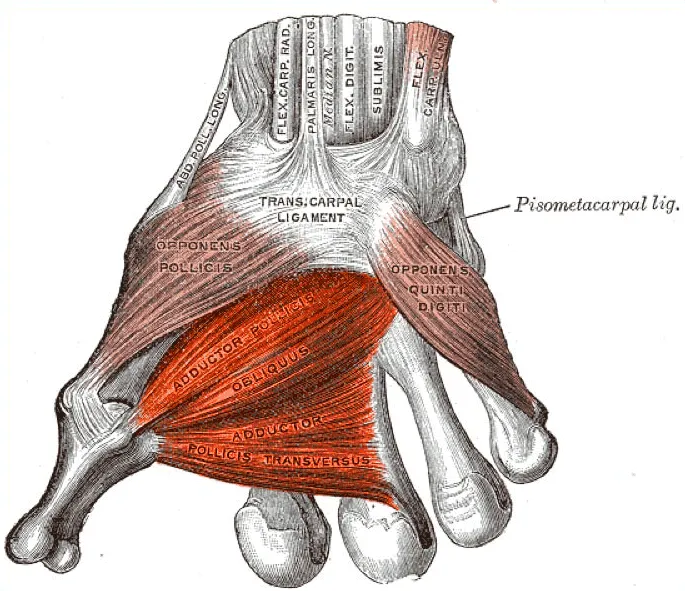
The oblique head (Latin: adductor obliquus pollicis) arises by several slips from the capitate bone, the bases of the second and third metacarpals, the intercarpal ligaments, and the sheath of the tendon of the flexor carpi radialis.
From this origin the greater number of fibers pass obliquely downward and converge to a tendon, which, uniting with the tendons of the medial portion of the flexor pollicis brevis and the transverse head of the adductor pollicis, is inserted into the ulnar side of the base of the proximal phalanx of the thumb, a sesamoid bone (the so-called adductor sesamoid) being present in the tendon of people aged 14 or older.
A considerable fasciculus, however, passes more obliquely beneath the tendon of the flexor pollicis longus to join the lateral portion of the flexor pollicis brevis and the abductor pollicis brevis.
Transverse head
The transverse head (Latin: adductor transversus pollicis) is deeply seated.
It is triangular, arising by a broad base from the lower two-thirds of the palmar surface of the third metacarpal bone; the fibers converge, to be inserted with the medial part of the flexor pollicis brevis and the oblique head into the ulnar side of the base of the proximal phalanx of the thumb.
Relations
The radial artery passes between the two heads, travelling from the back of the hand into the palm, where it forms the deep palmar arch.
Innervation
The adductor pollicis is innervated by the deep branch of the ulnar nerve (C8–T1).
Between the oblique and transverse heads is a thin fibrous arcade which the nerve passes as it traverses the palm laterally. The nerve is accompanied by the deep palmar arch.
Function
While adduction of the thumb (bringing it back into the plane of the palm of the hand from its previously abducted position) is mainly produced by the adductor pollicis, it can also bring the thumb to the side of the palm and index finger and the flexor pollicis brevis and the opponens pollicis help in thumb adduction.
Clinical significance
Froment's sign is used to test for a compromised adductor pollicis muscle.
In neuromuscular monitoring, the ulnar nerve is stimulated and the strength of adductor pollicis contraction is measured.
Source: Wikipedia, The Free Encyclopedia · CC BY-SA 4.0
References
- Adductor pollicis muscle — Wikipedia, The Free EncyclopediaText from the Wikipedia article "Adductor pollicis muscle" (CC BY-SA 4.0); excerpted. Licence. Retrieved 2026-10-19. Revision used.
Text above is quoted from the listed sources without changes to its meaning. Image credits and licences are shown with each image. Educational information only, not medical advice.
Educational anatomy reference, not medical advice. About this content.