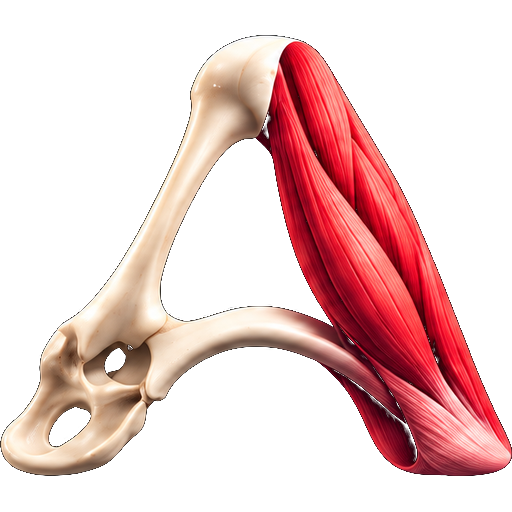
Brachialis
M. brachialis
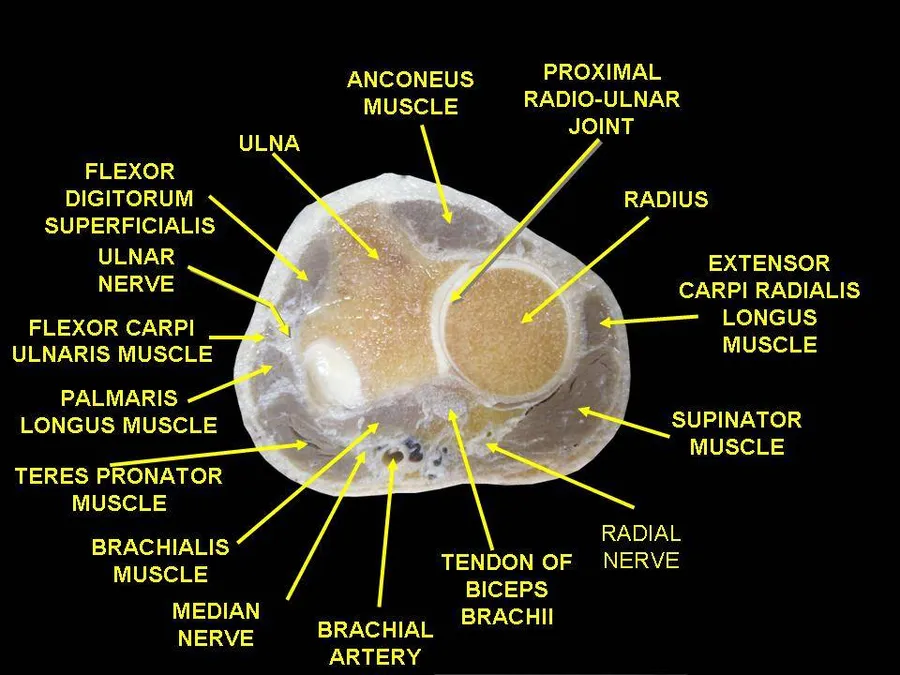
View the brachialis in 3DThe brachialis (also brachialis anticus or Casserio muscle) is a muscle in the upper arm that flexes the elbow. It lies beneath the biceps brachii, and makes up part of the floor of the region known as the cubital fossa (elbow pit). It originates from the anterior aspect of the distal humerus; it inserts onto the tuberosity of the ulna. It is innervated by the musculocutaneous nerve, and commonly also receives additional innervation from the radial nerve. The brachialis is the prime mover of elbow flexion generating about 50% more power than the biceps.
Origin
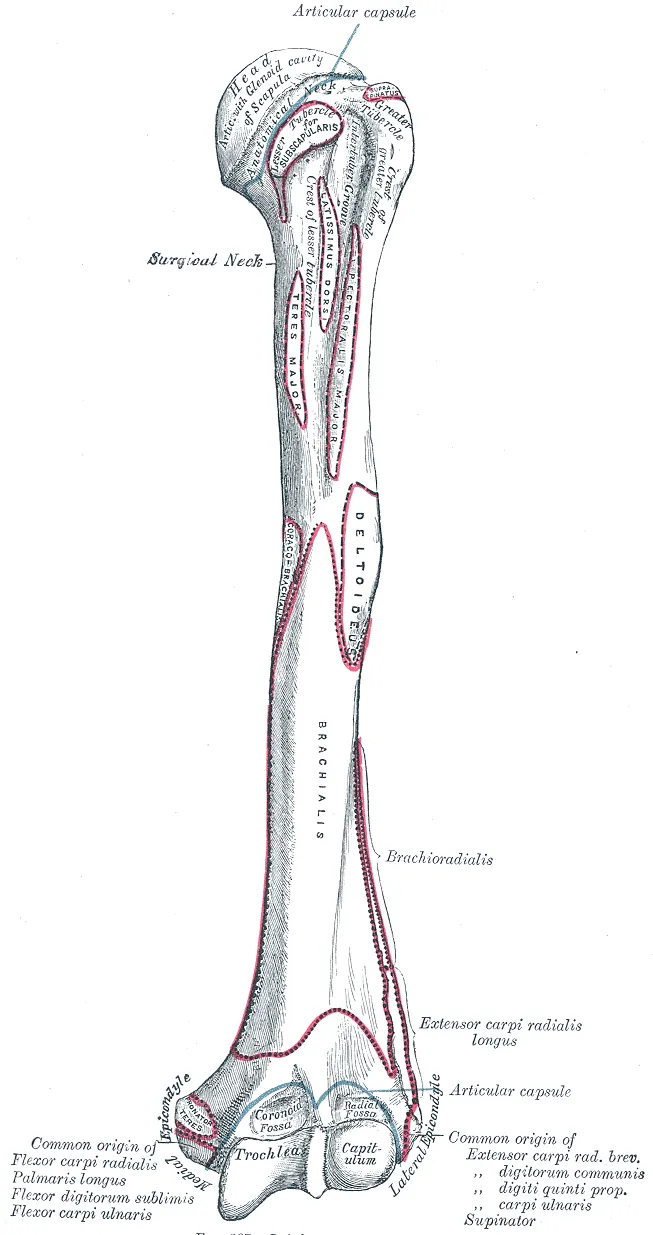
The brachialis originates from the anterior surface of the distal half of the humerus, near the insertion of the deltoid muscle, which it embraces by two angular processes. Its origin extends below to within 2.5 cm of the margin of the articular surface of the humerus at the elbow joint.
Insertion
Its fibers converge to a thick tendon which is inserted into the tuberosity of the ulna, and the rough depression on the anterior surface of the coronoid process of the ulna.
Innervation
The brachialis muscle is innervated by the musculocutaneous nerve (also Casserio nerve), which runs on its superficial surface, between it and the biceps brachii. However, in 70-80% of people, the muscle has double innervation with the radial nerve (C5-T1). The divide between the two innervations is at the insertion of the deltoid.
Blood supply
The brachialis is supplied by muscular branches of the brachial artery and by the recurrent radial artery.
Variation
The muscle is occasionally doubled; additional muscle slips to the supinator, pronator teres, biceps brachii, lacertus fibrosus, or radius are more rarely found.
Function
The brachialis flexes the arm at the elbow joint. It shares this function with the biceps brachii and the brachioradialis, with the brachialis being the most powerful flexor of the forearm. Unlike the biceps, the brachialis does not insert on the radius, and does not participate in pronation and supination of the forearm.
Source: Wikipedia, The Free Encyclopedia · CC BY-SA 4.0
References
- Brachialis muscle — Wikipedia, The Free EncyclopediaText from the Wikipedia article "Brachialis muscle" (CC BY-SA 4.0); excerpted. Licence. Retrieved 2026-10-19. Revision used.
Text above is quoted from the listed sources without changes to its meaning. Image credits and licences are shown with each image. Educational information only, not medical advice.
Educational anatomy reference, not medical advice. About this content.