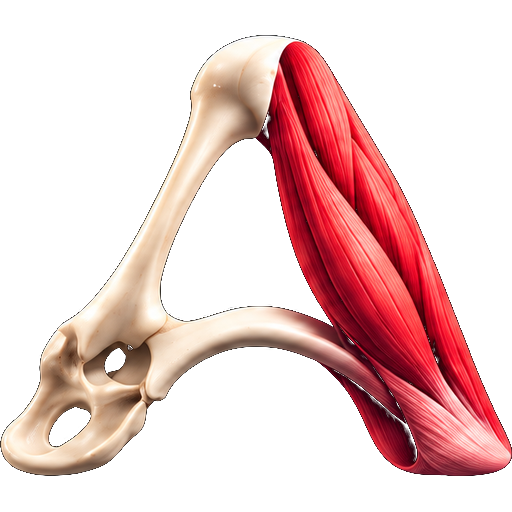
Flexor pollicis longus
M. flexor pollicis longus
View the flexor pollicis longus in 3DThe flexor pollicis longus (FPL, Latin flexor, bender; pollicis, of the thumb; longus, long) is a muscle in the forearm and hand that flexes the thumb. It lies in the same plane as the flexor digitorum profundus. This muscle is unique to humans, being either rudimentary or absent in other primates. A meta-analysis indicated accessory flexor pollicis longus is present in around 48% of the population.
Origin and insertion
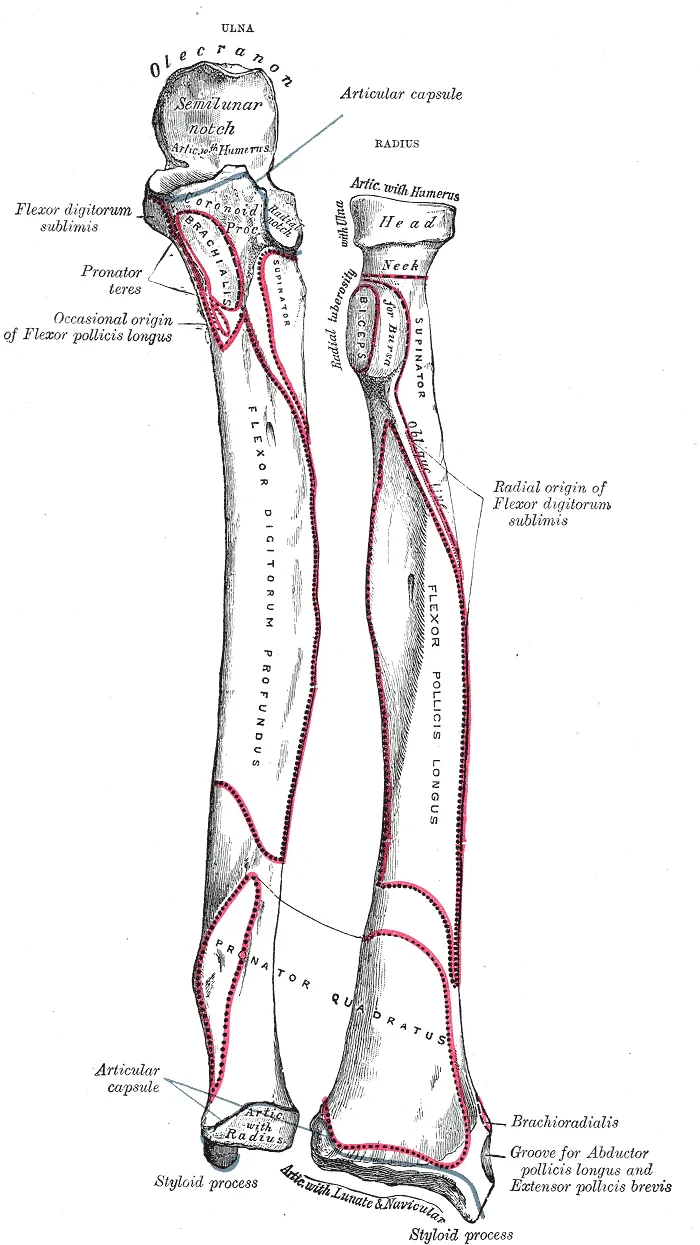
It arises from the grooved anterior (side of palm) surface of the body of the radius, extending from immediately below the radial tuberosity and oblique line to within a short distance of the pronator quadratus muscle. An occasionally present accessory long head of the flexor pollicis longus muscle is called 'Gantzer's muscle'. It may cause compression of the anterior interosseous nerve.
It arises also from the adjacent part of the interosseous membrane of the forearm, and generally by a fleshy slip from the medial border of the coronoid process of the ulna. In 40 percent of cases, it is also inserted from the medial epicondyle of the humerus, and in those cases a tendinous connection with the humeral head of the flexor digitorum superficialis is present.
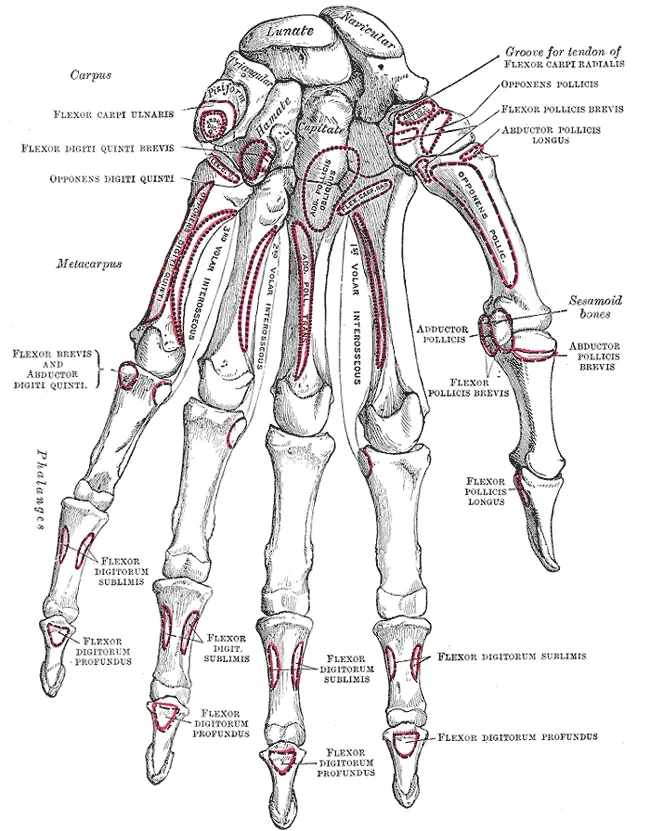
The fibers end in a flattened tendon, which passes beneath the flexor retinaculum of the hand through the carpal tunnel. It is then lodged between the lateral head of the flexor pollicis brevis and the oblique part of the adductor pollicis, and, entering an osseoaponeurotic canal similar to those for the flexor tendons of the fingers, is inserted into the base of the distal phalanx of the thumb.
Relations
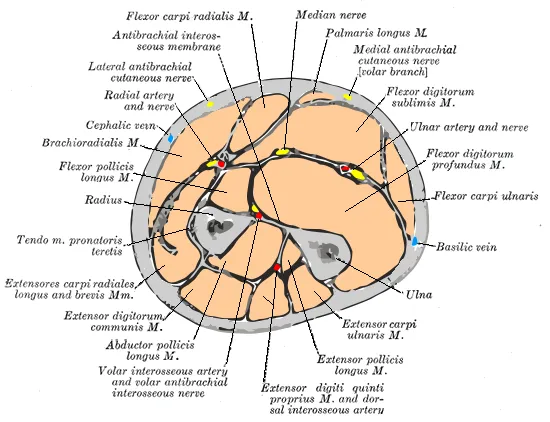
The anterior interosseous nerve (a branch of the median nerve) and the anterior interosseous artery and vein pass downward on the front of the interosseous membrane between the flexor pollicis longus and flexor digitorum profundus.
Injuries to tendons are particularly difficult to recover from due to the limited blood supply they receive.
Actions
The flexor pollicis longus is a flexor of the phalanges of the thumb; when the thumb is fixed, it assists in flexing the wrist.
Innervation
The flexor pollicis longus is supplied by the anterior interosseous(C8-T1) branch of the median nerve (C5-T1).
Variations
Slips may connect with flexor digitorum superficialis muscle, flexor digitorum profundus muscle (resulting in the Linburg-Comstock syndrome), or the pronator teres muscle. An additional tendon to the index finger is sometimes found.
Source: Wikipedia, The Free Encyclopedia · CC BY-SA 4.0
References
- Flexor pollicis longus muscle — Wikipedia, The Free EncyclopediaText from the Wikipedia article "Flexor pollicis longus muscle" (CC BY-SA 4.0); excerpted. Licence. Retrieved 2026-10-19. Revision used.
Text above is quoted from the listed sources without changes to its meaning. Image credits and licences are shown with each image. Educational information only, not medical advice.
Educational anatomy reference, not medical advice. About this content.