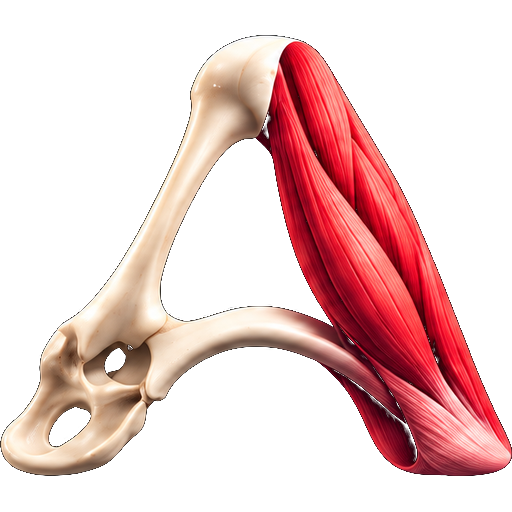
Sternothyroid
M. sternothyroideus
View the sternothyroid in 3DThe sternothyroid muscle (or sternothyroideus) is an infrahyoid muscle of the neck. It acts to depress the hyoid bone.
Structure
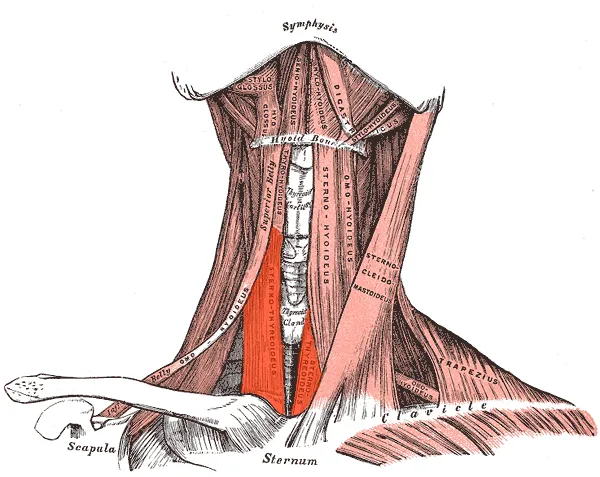
The two muscles are in contact with each other proximally (close to their origin), but diverge distally (towards their insertions).
Origin
The sternothyroid arises from the posterior surface of the manubrium of the sternum from the midline to the notch for the first rib (inferior to the origin of the sternohyoid muscle), and the posterior margin of the first costal cartilage.
Insertion
It inserts onto the oblique line of the lamina of thyroid cartilage.
Innervation
The sternothyroid muscle receives motor innervation from branches of the ansa cervicalis (ultimately derived from cervical spinal nerves C1-C3).
Relations
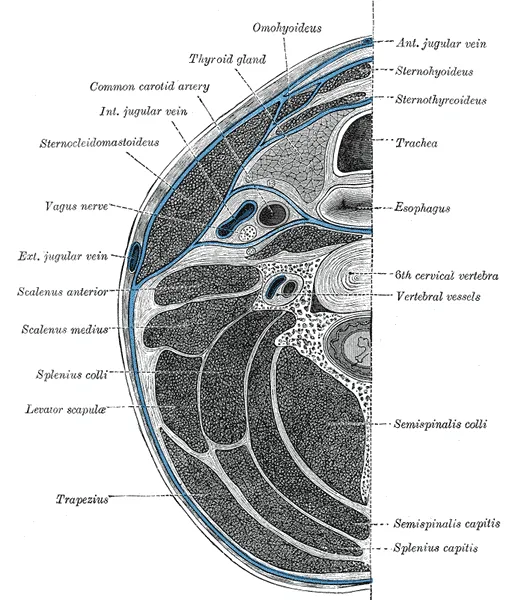
The sternothyroid muscle is shorter and wider than the sternohyoid muscle and is situated deep to and partially medial to it.
Variations
The muscle may be absent or doubled. It may issue accessory slips to the thyrohyoid muscle, inferior pharyngeal constrictor muscle, or the carotid sheath.
Actions/movements
The sternothyroid muscle indirectly depresses the hyoid bone by means of pulling the thyroid. When the hyoid bone is fixed, it instead elevates the larynx (producing an increased voice pitch).
Clinical significance
The upward extension of a thyroid swelling (goitre) is prevented by the attachment of the sternothyroid to the thyroid cartilage. A goitre can therefore only grow to the front, back or middle but no higher.
Source: Wikipedia, The Free Encyclopedia · CC BY-SA 4.0
References
- Sternothyroid muscle — Wikipedia, The Free EncyclopediaText from the Wikipedia article "Sternothyroid muscle" (CC BY-SA 4.0); excerpted. Licence. Retrieved 2026-10-19. Revision used.
Text above is quoted from the listed sources without changes to its meaning. Image credits and licences are shown with each image. Educational information only, not medical advice.
Educational anatomy reference, not medical advice. About this content.