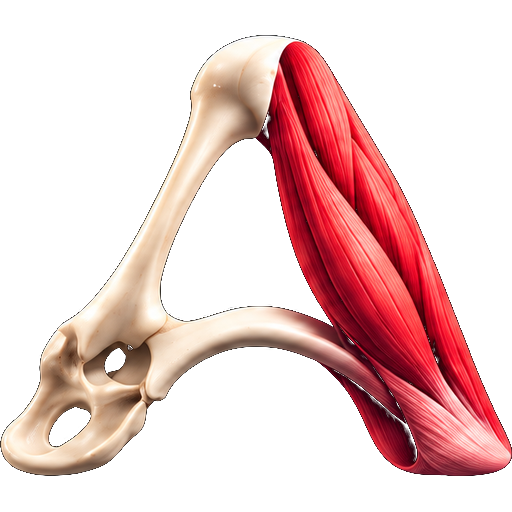
Teres major
M. teres major
View the teres major in 3DThe teres major muscle is a muscle of the upper limb. It attaches to the scapula and the humerus and is one of the seven scapulohumeral muscles. It is a thick but somewhat flattened muscle.
The teres major muscle (from Latin teres, meaning "rounded") is positioned above the latissimus dorsi muscle and assists in the extension and medial rotation of the humerus. This muscle is commonly confused as a rotator cuff muscle, but it is not, because it does not attach to the capsule of the shoulder joint, unlike the teres minor muscle, for example.
Structure
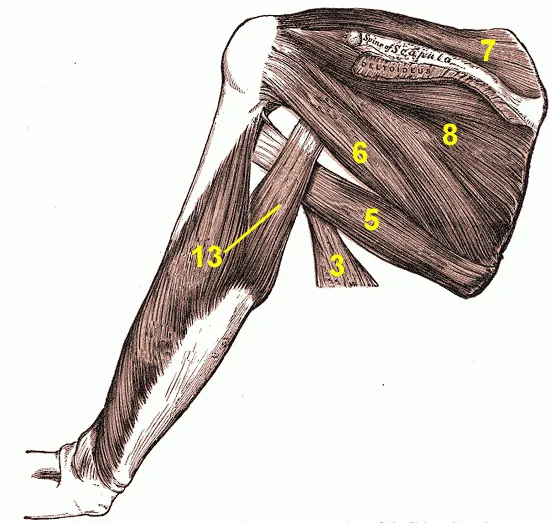
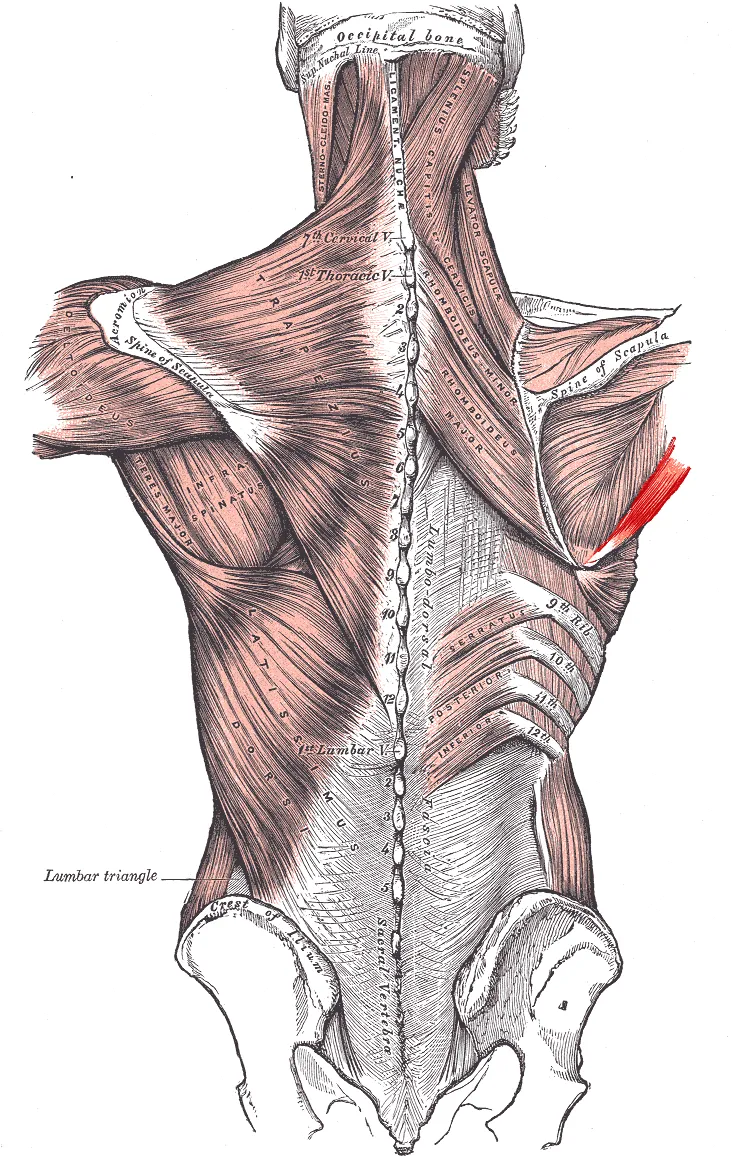
The teres major muscle originates on the dorsal surface of the inferior angle and the lower part of the lateral border of the scapula.
The fibers of teres major insert into the medial lip of the intertubercular sulcus of the humerus.
Relations
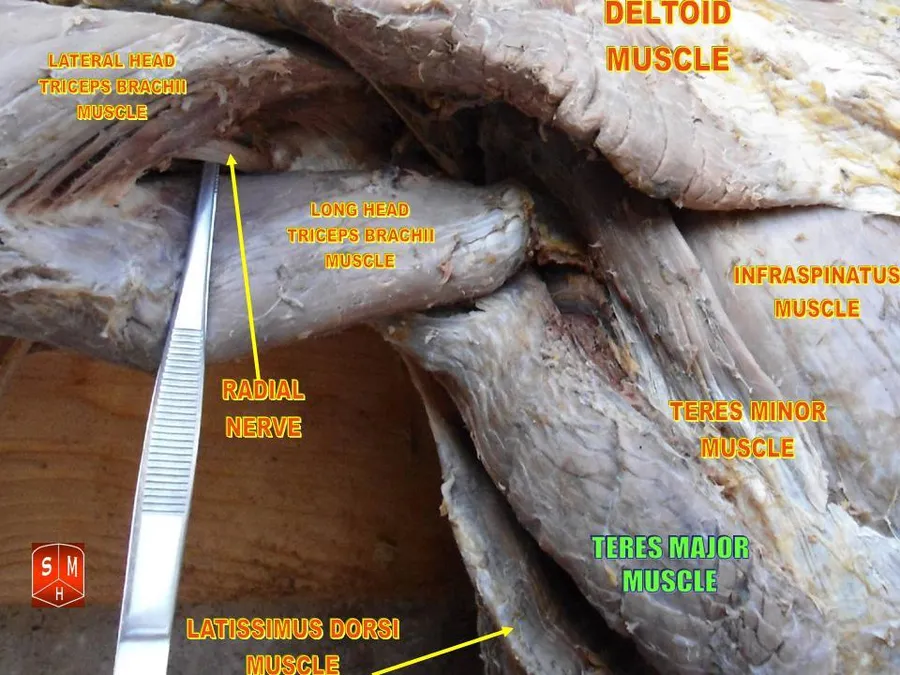
The tendon, at its insertion, lies behind that of the latissimus dorsi, from which it is separated by a bursa, the two tendons being, however, united along their lower borders for a short distance. The fibers of these two muscles run parallel to each other, and both muscles insert at the crest of the lesser tubercle of the humerus (also described as the medial lip of the intertubercular sulcus).
Together with teres minor muscle, teres major muscle forms the axillary space, through which several important arteries and veins pass.
Innervation
Teres major is supplied primarily by the lower subscapular nerve and additionally by the thoracodorsal nerve (middle subscapular nerve). These are distal to the upper subscapular nerve. These three nerves branch off the posterior cord of the brachial plexus. The nerves that innervate teres major consist of fibers from spinal nerves C5-C8.
Function
The teres major is a medial rotator and adductor of the humerus and assists the latissimus dorsi in drawing the previously raised humerus downwards and backwards (extension, but not hyperextension). It also helps stabilise the humeral head in the glenoid cavity.
Source: Wikipedia, The Free Encyclopedia · CC BY-SA 4.0
References
- Teres major muscle — Wikipedia, The Free EncyclopediaText from the Wikipedia article "Teres major muscle" (CC BY-SA 4.0); excerpted. Licence. Retrieved 2026-10-19. Revision used.
Text above is quoted from the listed sources without changes to its meaning. Image credits and licences are shown with each image. Educational information only, not medical advice.
Educational anatomy reference, not medical advice. About this content.