Sweat gland
Glandula sudorifera
View the sweat gland in 3DSweat glands, also known as sudoriferous or sudoriparous glands, from Latin sudor 'sweat', are small tubular structures of the skin that produce sweat. Sweat glands are a type of exocrine gland, which are glands that produce and secrete substances onto an epithelial surface by way of a duct. There are two main types of sweat glands that differ in their structure, function, secretory product, mechanism of excretion, anatomic distribution, and distribution across species:
Eccrine sweat glands are distributed almost all over the human body, in varying densities, with the highest density in palms and soles, then on the head, but much less on the trunk and the extremities. Their water-based secretion represents a primary form of cooling in humans.
Apocrine sweat glands are mostly limited to the axillae (armpits) and perineal area in humans. They are not significant for cooling in humans, but are the sole effective sweat glands in hoofed animals, such as the camels, donkeys, horses, and cattle.
Ceruminous glands (which produce ear wax), mammary glands (which produce milk), and ciliary glands in the eyelids are modified apocrine sweat glands.
Structure
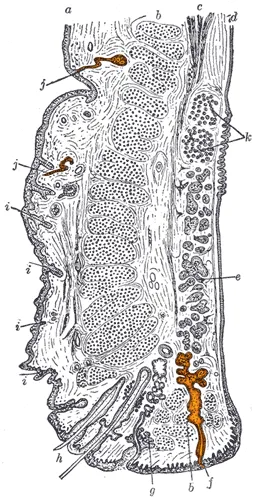
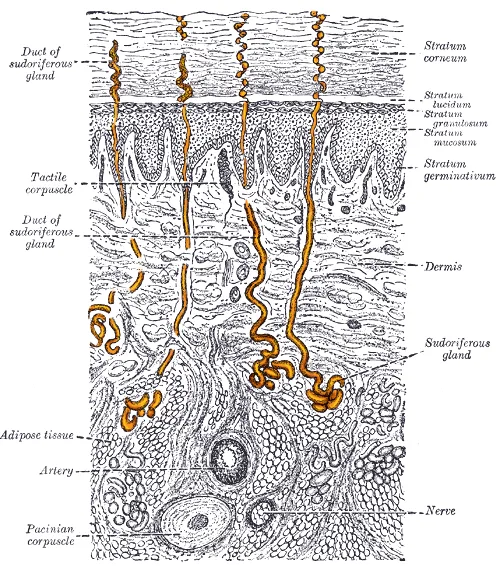
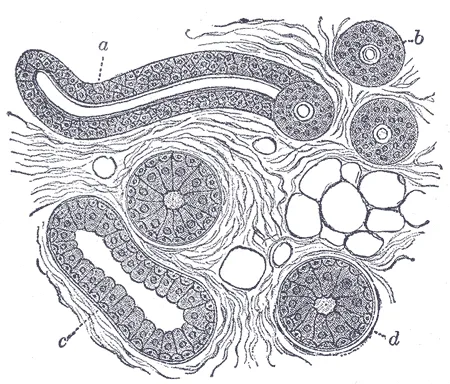
Generally, sweat glands consist of a secretory unit that produces sweat, and a duct that carries the sweat away. The secretory coil or base, is set deep in the lower dermis and hypodermis, and the entire gland is surrounded by adipose tissue. In both sweat gland types, the secretory coils are surrounded by contractile myoepithelial cells that function to facilitate excretion of secretory product. The secretory activities of the gland cells and the contractions of myoepithelial cells are controlled by both the autonomic nervous system and by the circulating hormones. The distal or apical part of the duct that opens to the skin's surface is known as the acrosyringium.
Each sweat gland receives several nerve fibers that branch out into bands of one or more axons and encircle the individual tubules of the secretory coil. Capillaries are also interwoven among sweat tubules.
Distribution
The number of active sweat glands varies greatly among different people, though comparisons between different areas (ex. axillae vs. groin) show the same directional changes (certain areas always have more active sweat glands while others always have fewer). According to Henry Gray's estimates, the palm has around 370 sweat glands per cm2; the back of the hand has 200 per cm2; the forehead has 175 per cm2; the breast, abdomen, and forearm have 155 per cm2; and the back and legs have 60–80 per cm2.
In the finger pads, sweat glands pores are somewhat irregularly spaced on the epidermal ridges. There are no pores between the ridges, though sweat tends to spill into them. The thick epidermis of the palms and soles causes the sweat glands to become spirally coiled.
Other animals
Non-primate mammals have eccrine sweat glands only on the palms and soles. Apocrine glands cover the rest of the body, though they are not as effective as humans' in temperature regulation (with the exception of horses'). Prosimians have a 1:20 ratio of follicles with apocrine glands versus follicles without. They have eccrine glands between hairs over most of their body (while humans have them between the hairs on their scalp).
The overall distribution of sweat glands varies among primates: the rhesus and patas monkeys have them on the chest; the squirrel monkey has them only on the palms and soles; and the stump-tailed macaque, Japanese monkey, and baboon have them over the entire body.
Domestic animals have apocrine glands at the base of each hair follicle, but eccrine glands only in foot pads and snout. Their apocrine glands, like those in humans, produce an odorless oily milky secretion evolved, not to evaporate and cool, but rather to coat and stick to hair so that odor-causing bacteria could grow on it. Likewise, glands on their foot pads, like those on the palms and soles of humans, did not evolve to cool, but rather to increase friction and enhance grip.
Dogs and cats have apocrine glands that are specialized in both structure and function located at the eyelids (Moll's glands), ears (ceruminous glands), anal sac, clitoral hood, and circumanal area.
Source: Wikipedia, The Free Encyclopedia · CC BY-SA 4.0
References
- Sweat gland — Wikipedia, The Free EncyclopediaText from the Wikipedia article "Sweat gland" (CC BY-SA 4.0); excerpted. Licence. Retrieved 2026-10-19. Revision used.
Text above is quoted from the listed sources without changes to its meaning. Image credits and licences are shown with each image. Educational information only, not medical advice.
Educational anatomy reference, not medical advice. About this content.